
Europe Swapped Russian Gas for Gulf Oil — Now Hormuz Is on Fire
Four years after Brussels declared victory over Russian energy dependence, a single military operation has exposed the hollowness of that triumph. When US and Israeli forces struck Iranian military infrastructure in February 2026, Brent crude rocketed from $87 to $109 a barrel in seventy-two hours — the sharpest three-day spike since Saddam Hussein's tanks rolled into Kuwait in 1990. Futures contracts briefly touched $140. And Europe, which had spent four years congratulating itself on breaking free from Moscow's energy grip, suddenly found itself staring at a different trap entirely.
The Strategic Autonomy Paradox
The EU's post-2022 energy pivot was, by any reasonable measure, a success story. Brussels slashed Russian pipeline gas imports from roughly 40% of supply to under 15% by 2025. New LNG terminals were constructed in record time in Germany, the Netherlands, and Greece. The dependency on Moscow shrank. The problem, now laid bare, is where the replacement energy actually comes from.
Every major alternative supply route — LNG from Qatar, crude from Saudi Arabia, the UAE, and Iraq — transits the Strait of Hormuz, the twenty-one-mile chokepoint through which approximately 17 to 18 million barrels of oil pass daily. Europe didn't escape energy dependency. It traded a Russian pipeline for a Gulf corridor, and handed the security of that corridor to the US Navy.
Want to go deeper? Listen to the 20-minute investigative deep dive on this topic.
Listen to EpisodeThis is what international relations scholars call the "strategic autonomy paradox": each step toward independence from one adversary deepened reliance on another actor's military protection. The EU published frameworks, held summits, and created procurement mechanisms. None of it changed the underlying geography.
The timeline mismatch is structural, not a planning failure. Building renewable capacity, expanding nuclear infrastructure, and developing hydrogen supply chains are decade-long projects. The immediate post-2022 imperative was to keep European factories running and homes heated. LNG terminals delivered that. But those terminals need gas, that gas comes through Hormuz, and Hormuz is now a crisis zone.
A Recession Trigger, Not a Rounding Error
The economic stakes are not abstract. Internal European Commission modeling, portions of which were leaked to the Financial Times in late February, estimated that a sustained two-week closure of the Strait of Hormuz would cost the EU economy between 1.2% and 1.8% of GDP within a single quarter. That is not a side effect. That is a recession trigger — and it would arrive on top of an industrial base already weakened by three years of elevated energy costs.
With Iranian-backed militias threatening retaliation across the strait, the threat of even a partial disruption has already pushed European energy futures sharply higher. Southern European refineries, which depend most heavily on Gulf crude, are the most immediately exposed. But the price shock propagates across the entire continental economy through manufacturing input costs, transport, and consumer energy bills.
Twenty-Seven Member States, Zero Consensus
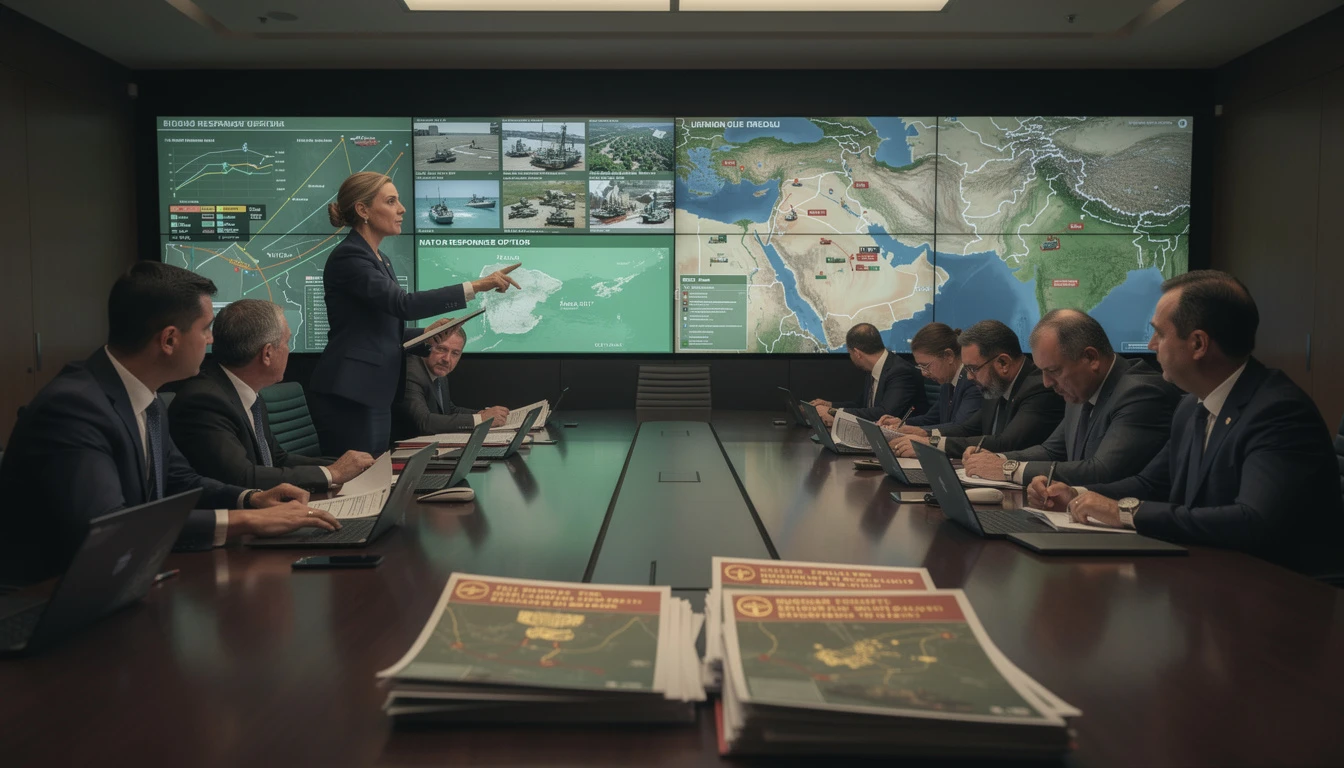
Europe's institutional response has been, predictably, fractured. France, with its own military presence in the UAE and a nuclear-powered carrier in the Indian Ocean, pushed immediately for a European-led naval patrol mission in the Gulf of Oman. Germany, whose industrial base is acutely sensitive to energy price shocks, prioritized diplomatic channels — calling for an emergency UN Security Council session and back-channel engagement with whatever remains of Iranian civilian governance.
The smaller eastern member states — Poland, the Baltic states, the Czech Republic — are watching through an entirely different lens. For them, the primary security threat remains Russia. Every diplomatic and military resource diverted to the Gulf is one not focused on NATO's eastern flank.
This isn't indecision. It is the predictable output of a system designed for consensus operating in a crisis that demands speed. The Common Foreign and Security Policy requires unanimity for most major actions. Hungary, which has maintained closer ties with Moscow throughout the Ukraine conflict, has already signaled reluctance to endorse any EU action that could be construed as legitimizing the US-Israeli strikes. One dissenting member state can paralyze the entire apparatus.
How Every Major Power Is Being Stress-Tested
The strikes function as a simultaneous stress test of multiple global systems, and the results are counterintuitive across the board.
Russia appears to be an obvious beneficiary — every dollar increase in oil prices flows into the Kremlin's war chest, and Moscow's 2026 budget was built on a $70-per-barrel assumption. But the strategic calculus is more complicated. Russia spent a decade positioning itself as a reliable partner to all sides in the Middle East — arming Iran, maintaining relations with Israel, building OPEC+ partnerships with Gulf states. The strikes obliterate that balancing act, forcing Moscow to choose between supporting Tehran and protecting the Gulf Arab relationships that have served as crucial sanctions-evasion channels.
China holds 73% crude import dependency, with a significant share transiting Hormuz. Belt and Road infrastructure assets worth tens of billions of dollars sit in the blast radius of regional instability. Beijing's public rhetoric has been sharply critical of the strikes. Privately, the calculation diverges: a weakened, isolated Iran may prove a more dependent Iran — more willing to accept Chinese investment on Chinese terms, more reliant on Beijing's diplomatic cover. The public condemnation and the private strategic interest are moving in opposite directions.
The United States has framed the operation as decisive action without a ground-war quagmire. But the cost accounting has gaps. Defense analysts estimate the strikes consumed somewhere between 400 and 800 precision-guided munitions — drawing down stockpiles already under strain from commitments to Ukraine and Taiwan contingency planning, against a Tomahawk production rate of roughly 150 units per year.
What to Watch
The immediate variable is whether Iranian-backed militias attempt a sustained Hormuz disruption or whether the threat remains a pressure tactic. Even a partial, temporary closure would validate the worst-case Commission modeling and accelerate political pressure within the EU for emergency energy measures.
Longer term, the crisis has exposed a hard ceiling on European strategic autonomy that no institutional reform can quickly overcome. The energy geography locked in by post-2022 LNG terminal construction will shape European vulnerability for at least the next decade. The question now is whether this moment produces the political will to accelerate the renewable and nuclear buildout that genuine independence requires — or whether Europe simply waits for the next chokepoint to catch fire.