
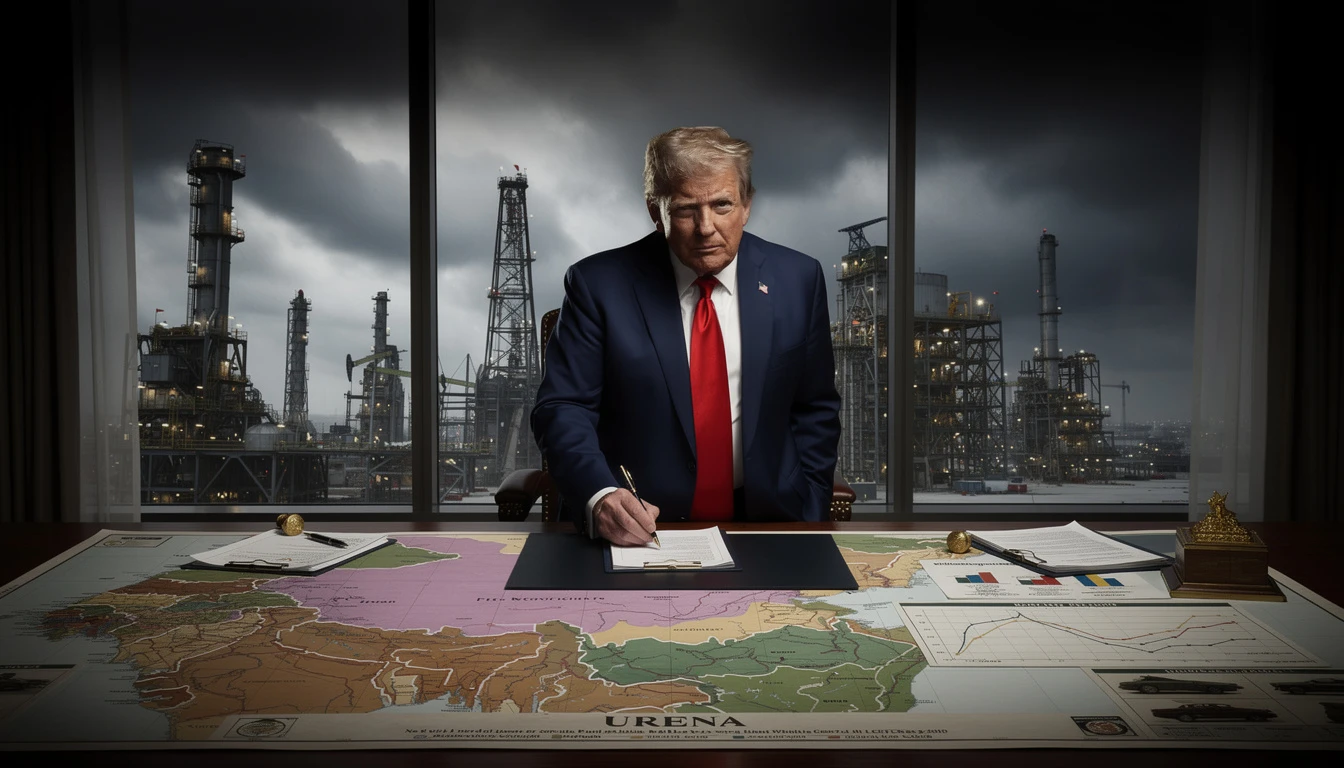
America's Oil Dominance Strategy May Be Fueling China's Energy Independence
The United States pumped more than 13 million barrels of crude oil per day in January 2026 — the highest output of any nation in recorded history. Within the same month, Washington ordered military strikes on Iranian energy infrastructure, moved to effectively seize Venezuelan oil assets, and leaned on OPEC to keep global supply constrained. The world's most oil-rich nation was behaving like a country under siege.
That contradiction is not an accident. It is the operating logic of energy dominance — a doctrine that has less to do with fuel security and everything to do with geopolitical coercion, with China squarely in its crosshairs. But analysts and energy economists are increasingly warning that the strategy may be engineering the very outcome it was designed to prevent.
A Doctrine Built on Leverage, Not Supply
Energy dominance first emerged as White House rhetoric around 2017, when the U.S. was still a net energy importer. By 2026, the aspirational has become operational: America is simultaneously the world's largest oil producer, largest natural gas producer, and a dominant LNG exporter. On paper, the strategy succeeded.
Want to go deeper? Listen to the 20-minute investigative deep dive on this topic.
Listen to EpisodeYet the military and economic aggression has intensified, not receded. The reason, according to foreign policy analysts, is that the doctrine was never primarily about energy supply. It is about denying China reliable, affordable alternatives.
The targets are not random. Iran supplies roughly 12 percent of China's crude imports. Venezuela, before its economic collapse, was a cornerstone of Beijing's Belt and Road energy portfolio. Each U.S. action against these nations disrupts a node in China's alternative supply chain, forcing Beijing to either pay more for energy or accelerate its pivot away from hydrocarbons entirely.
The timing of the Iran strikes is particularly instructive. U.S. forces hit Iranian oil export terminals at Kharg Island and Bandar Abbas 72 hours after Tehran finalized a 25-year oil supply agreement with China, guaranteeing Beijing discounted crude at approximately $62 per barrel. That deal would have locked in cheap energy for Chinese manufacturing and undercut American LNG exports to Asia. The terminals were burning before the ink was dry.
The Financial Fingerprints
The policy's beneficiaries are not difficult to identify. The administration's energy advisory board is populated by executives from Continental Resources, ExxonMobil, and Cheniere Energy — companies that are direct financial beneficiaries of every barrel pumped and every LNG cargo shipped abroad.
The lobbying infrastructure reinforces the picture. The American Petroleum Institute spent more than $280 million on federal lobbying and political contributions in 2025 alone — nearly triple its 2020 spending. When Iranian export terminals were struck and Brent crude spiked to $91 per barrel, Continental Resources' stock jumped 14 percent in a single week. Cheniere gained 9 percent. The advisors who shaped the policy profited from its execution.
The Venezuela operation follows a different but equally revealing playbook. Rather than military force, Washington recognized an opposition government-in-exile, froze Maduro regime assets in U.S. banks, and offered to "manage" Venezuelan oil production through American companies in exchange for sanctions relief. Venezuela holds the world's largest proven oil reserves — over 300 billion barrels — and its people are enduring a humanitarian catastrophe, with 7 million refugees and collapsing public services. The American offer was not reconstruction aid. It was a corporate acquisition dressed as diplomacy.
The Volatility Machine
The strategy's architecture is precise: sanctions on Iran, a stranglehold on Venezuela, and coordinated OPEC production cuts combine to create a global supply environment where American crude becomes one of the few reliable options. The result is a predictable oil price band of $65 to $90 per barrel — tight enough to squeeze competitors, wide enough to keep U.S. shale producers profitable.
But that volatility is not neutral. For import-dependent economies — India, Indonesia, much of sub-Saharan Africa — it translates directly into food prices, electricity costs, and healthcare access. Refinery communities and Caribbean island nations absorb the human cost of price swings engineered in Washington and executed through aircraft carriers and sanctions orders.
The financial logic also contains a structural flaw. American shale production carries a breakeven price of $62 to $68 per barrel in the Permian Basin for new wells in 2026. Shale wells lose 40 to 60 percent of production in their first year, requiring constant capital reinvestment to maintain output. The industry spent years promising Wall Street "capital discipline." Energy dominance demands the opposite — maximum drilling, maximum exposure, maximum geopolitical risk.
The Trap Closing Around the Strategy Itself
The deepest irony of energy dominance may be its most consequential failure: by weaponizing oil flows to block China's energy independence, Washington is accelerating Beijing's renewable energy buildout.
China's clean energy investment reached a record $675 billion in 2024, according to BloombergNEF. Partly this reflects economic logic — renewables are now undercutting fossil fuels in market after market. But partly, analysts argue, it reflects a strategic calculation forced by American pressure: if hydrocarbon supply can be weaponized, the only durable solution is to stop needing hydrocarbons.
The same dynamic is playing out domestically. The AI data centers that the current administration champions as America's technological future are signing 20-year power purchase agreements with wind and solar, not natural gas. The International Energy Agency's 2026 World Energy Outlook projects that global oil demand must peak by 2028 to meet even a two-degree climate pathway. Energy dominance does not merely ignore that timeline — it actively works against it.
What to Watch
The doctrine's internal contradictions are approaching a reckoning. If oil prices remain below $80, shale producers face margin compression that undermines the production volumes the strategy requires. If prices spike above $90 — as they briefly did after the Iran strikes — the political cost of inflation at home becomes a liability.
Meanwhile, every month China operates under American energy pressure is another month Beijing has to justify accelerating its decoupling from fossil fuel imports. The policy designed to make the world dependent on American hydrocarbons may be the most effective renewable energy subsidy China never had to pay for.
The executives on federal advisory boards, the lobbying expenditures, and the military operations are all visible. What remains to be seen is whether the strategy's architects have modeled what happens when the leverage runs out — and the trap closes on the wrong side.